
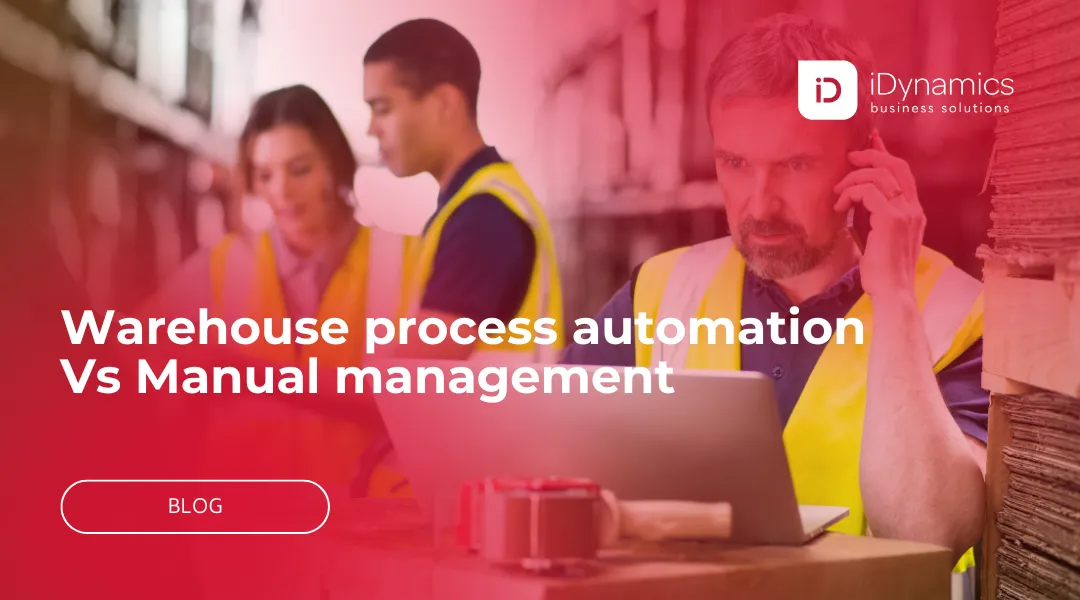
In this environment, warehouse automation is no longer optional—it’s a competitive necessity.
But does it really make sense to move away from manual warehouse management?
In this guide, we break down the differences, benefits, and real-world impact of both models—and explain why iDynamics Warehouse is helping companies transition to smarter, scalable operations.
What Is manual warehouse management?
Manual warehouse management refers to logistics operations that rely primarily on human labor instead of automated systems.
Typical processes include:
- Manual picking (workers walking the warehouse to pick items).
- Packing and shipping preparation.
- Inventory tracking using spreadsheets or paper records.
While this approach works for smaller operations, its limitations become clear as complexity grows.
Pros and cons of manual warehouse management
Advantages
- Low upfront cost: No need for advanced software or automation infrastructure.
- Operational flexibility: Easy to adapt workflows quickly without system constraints.
Disadvantages
- High risk of human error in picking, inventory, and shipping.
- Limited scalability as growth requires more staff, not more efficiency.
- Lack of real-time visibility, leading to poor decision-making.
- Rising operational costs over time.
What Is warehouse process automation?
Warehouse automation uses advanced technologies to execute logistics operations with minimal human intervention.
Instead of depending on manual work, companies leverage systems that optimize speed, accuracy, and efficiency across the entire warehouse lifecycle.
Key warehouse automation technologies
Modern warehouses rely on a combination of software and hardware:
- WMS (Warehouse Management System): The central brain coordinating inventory, picking routes, and workflows
- AS/RS (Automated Storage and Retrieval Systems): Automatically store and retrieve goods for maximum efficiency
- AMRs (Autonomous Mobile Robots): Transport goods across the warehouse without fixed infrastructure
- Warehouse robotics and cobots: Assist or fully automate picking, packing, and material handling
The power of software + hardware integration
The real value of automation comes from integration.
A robust WMS connects:
- Robots and physical systems (AMRs, sensors, scanners)
- ERP platforms (like Microsoft Dynamics 365)
- Real-time data flows across all operations
For example, an automated workflow might look like:
- A customer order enters the system
- The WMS assigns optimal picking routes
- An AMR retrieves the product
- Inventory is updated instantly
The result? A high-performance, data-driven warehouse operation.
Manual vs Automated warehouse: Key differences
Here’s how the two models compare:
Performance comparison
| Criteria | Manual Management | Automated Warehouse (iDynamics) |
|---|---|---|
| Speed & productivity | Slow, dependent on human pace | Up to 3x faster with continuous operations |
| Accuracy | High error rates | Near 100% accuracy with automation |
| Costs & ROI | Low initial cost, high long-term cost | Higher upfront investment, fast ROI |
| Scalability | Limited | Highly scalable with demand |
| Visibility | Fragmented data | Real-time full visibility |
| Efficiency | Labor-driven | Process-driven and optimized |
The conclusion is clear: manual systems cannot keep up with modern logistics demands.
Industry trends: Why automation Is accelerating
Warehouse automation is not just a trend—it’s a market shift.
According to industry projections:
- The warehouse automation market is expected to grow dramatically over the next decade.
- Companies of all sizes are investing to improve efficiency and reduce operational costs.
Emerging technologies shaping the future:
- Artificial Intelligence (AI) for demand forecasting and route optimization.
- Computer vision systems for better picking accuracy.
- Real-time analytics for continuous optimization.
Companies that delay adoption risk falling behind competitors already leveraging automation.
Why iDynamics Warehouse stands out
When it comes to warehouse automation, not all solutions are equal.
iDynamics Warehouse is built specifically to help mid-sized and growing companies scale operations efficiently—especially within the Microsoft ecosystem.
- Tailored automation for real business needs
Unlike generic systems, iDynamics delivers customized automation solutions aligned with your workflows and industry requirements.
- Native integration with Microsoft Dynamics 365
Unlike standalone tools, iDynamics integrates directly with Microsoft Dynamics 365 Business Central, connecting:
- Inventory.
- Sales.
- Purchasing.
- Logistics.
This eliminates data silos and ensures real-time synchronization across your business.
- Measurable business impact
Companies using iDynamics Warehouse achieve:
- Reduced picking and inventory errors.
- Faster order fulfillment.
- Full visibility of stock and operations.
- Lower operational costs.
The bottom line: automation is the growth lever
Manual warehouse management may work in early stages—but it quickly becomes a bottleneck.
Automation, on the other hand, enables:
- Scalable growth.
- Operational efficiency.
- Data-driven decision-making.
And with iDynamics Warehouse, you don’t just automate—you build a future-ready warehouse ecosystem.
Ready to modernize your aarehouse? If you’re evaluating warehouse automation solutions, the key question isn’t if you should automate—but how fast you can do it. Talk to an expert!



0 Comments